Basically, you cling to this belief that less tax on the rich means more jobs, which is the opposite of the belief i cling to: "THE RICH CONTROL THE LAWS, CONTROL THE TAX RATE, CONTROL THE MEDIA, and control manipulable minds like yours into thinking that them having lower taxes results in jobs."
You know what, I'll admit you are right. It probably does lead to more jobs. Real @#(!ty, low paying jobs that keep the populaces' time occupied and busy so they don't have enough time to think of what a @#(!hole they live in and can never have the time to break free of it and organize a rEvolution. Jobs that offer no chance of retirement or other benefits.
Bravo you won the argument. Lets make 0% tax rates on the rich. And give them money too! so they'll make even more (@#(!ty) jobs. Like cleaning their laundry and dishes.
Lets be like robin hood, but in reverse. Lets steal from the poor and give to the rich. Oh wait we already do that. In the form of inflation, and payroll taxes. Yay for all the "job creators" that pay NO TAXES:
http://www.thedailybeast.com/articles/2 ... taxes.html
http://finance.yahoo.com/news/companies-pa...0.html?page=all
http://thinkprogress.org/economy/2012/04/0...axes-four-year/
So basically the "job creators" are already paying so little in taxes, why are we still in a recession? By your logic there should be 0% unemployment, and the economy should be booming!
The Rich & Job Creation
The age old parenting trick; One kid will cut it but the other chooses first. There is a reason this is done. In my long and varied life I have seen time and again people have great difficulty when they feel that they were "Cheated" i.e. got less then everyone/someone else even to very small differences in shares. Being generous with your stuff is not the same as being ok with getting the smaller slice.Adept wrote:QUOTE (Adept @ Aug 6 2013, 06:26 PM) Subjective to a degree, but also utterly fundamental to the human psyche. Evolution has favoured fairness and cooperation, and continues to do so. Small children asked to split a cake, for instance tend to make equal shares, and are furious if the ne doing the split tries to cheat. http://www.bbc.co.uk/news/science-environment-23529849
Last edited by MrChaos on Wed Aug 07, 2013 12:12 am, edited 1 time in total.
Ssssh
-
takingarms1
- Posts: 3052
- Joined: Fri Feb 20, 2004 8:00 am
You're not even reading what I'm writing anymore.Ryujin wrote:QUOTE (Ryujin @ Aug 6 2013, 06:35 PM) Basically, you cling to this belief that less tax on the rich means more jobs, which is the opposite of the belief i cling to: "THE RICH CONTROL THE LAWS, CONTROL THE TAX RATE, CONTROL THE MEDIA, and control manipulable minds like yours into thinking that them having lower taxes results in jobs."
What I am actually trying to communicate is that in certain circumstances, lower taxes stimulates the economy, and in certain circumstances IT DOESN'T. Or at least not much.
And your diatribe of "the rich control the laws" blah blah is crazy conspiracy theory nonsense. I agree that some rich people affect government through lobbying, propaganda, etc. I don't agree that all those rich people agree on their politics and want the same things to happen. Also, if rich people controlled everything, I suspect the statistics wouldn't reflect that the top ten percent of earners pay 70% of the taxes. And also we probably wouldn't have all the social welfare programs we have. etc.
"You give my regards to St. Peter. Or, whoever has his job, but in hell!"
- - - -
- - - -
-
takingarms1
- Posts: 3052
- Joined: Fri Feb 20, 2004 8:00 am
I was curious after reading this and decided to look up median income in the US versus the rest of the world. The reason I had questions is because it seemed really strange to me that the US would be so far down, when it seems like the US has some of the highest paying jobs in the world. So here's what I found: this link says USA is #2 in median income in the world..raumvogel wrote:QUOTE (raumvogel @ Jul 24 2013, 10:21 PM) U.S. middle class VS. World
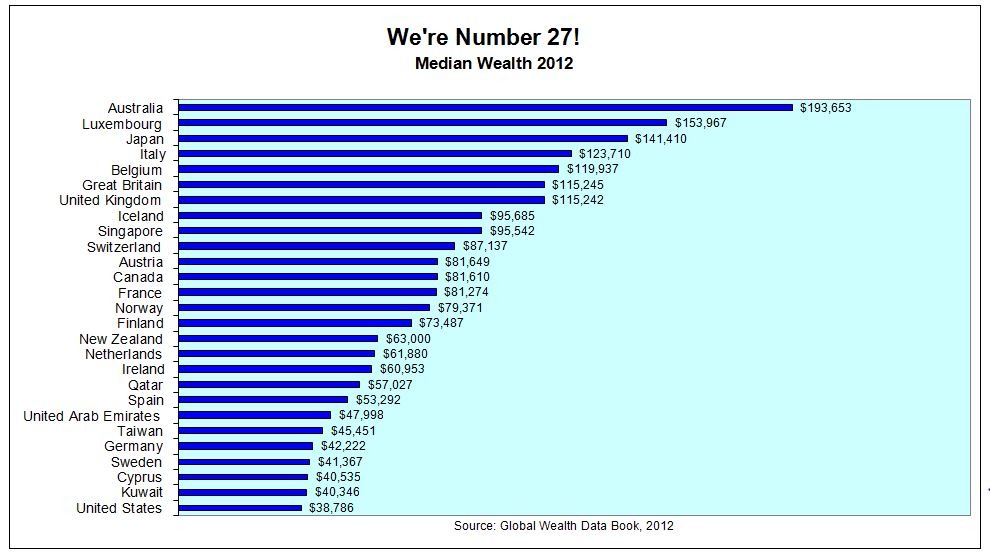
What does this mean? How come we're #27 in median wealth, but #2 in median income? Perhaps it has to do with spending habits in the US, and our general propensity not to save? In any case, it strikes me that all the people who seemed to be suggesting that middle class people in the US enjoy a lower standard of living than 26 other countries are probably full of @#(!.
"You give my regards to St. Peter. Or, whoever has his job, but in hell!"
- - - -
- - - -
So TA, you have taken this argument to comparing the US to the rest of the world, when it is just about destroying the myth that the rich are job creators. Get back on track.
Who cares what the standard of living is? Even your link makes reference to
QUOTE I should warn that estimates of median income are much less reliable than GDP per capita.[/quote]
Its about what the standard of living COULD be if a larger portion of income in redistributed by the rich.
Hell, Australia makes billions through coal exports. But we aren't a country of mining magnates or enjoy the kick to our median incomes because most of that money goes offshore to foreign investors.
We tried a mining superprofits tax, but the 'rich' killed it and the political aspirations of the leader of government who tried to bring it in (Kevin Rudd). So, Ryu's points are well founded. Australia gets the benefits of some jobs, but only 20% of the wealth. ITS OUR RESOURCES FFS!!
Who cares what the standard of living is? Even your link makes reference to
QUOTE I should warn that estimates of median income are much less reliable than GDP per capita.[/quote]
Its about what the standard of living COULD be if a larger portion of income in redistributed by the rich.
Hell, Australia makes billions through coal exports. But we aren't a country of mining magnates or enjoy the kick to our median incomes because most of that money goes offshore to foreign investors.
We tried a mining superprofits tax, but the 'rich' killed it and the political aspirations of the leader of government who tried to bring it in (Kevin Rudd). So, Ryu's points are well founded. Australia gets the benefits of some jobs, but only 20% of the wealth. ITS OUR RESOURCES FFS!!

-
takingarms1
- Posts: 3052
- Joined: Fri Feb 20, 2004 8:00 am
Sure, accuse me of non-sequiturs then throw one in yourself without any support. Well since you didn't bother to look it up, the US is #7 in GDP per capita. Still a far cry from #27.
Anyway, as to your completely anecdotal evidence about coal mining in your country, I don't see what it has to do with any "myth" about rich people being job creators.
I would also point out that I never said the "rich" were job creators. I said entrepreneurs, the risk takers, are job creators. Many of them start out being just as poor as you, and then become rich after creating companies that employ people (i.e. creating jobs).
Anyway, as to your completely anecdotal evidence about coal mining in your country, I don't see what it has to do with any "myth" about rich people being job creators.
I would also point out that I never said the "rich" were job creators. I said entrepreneurs, the risk takers, are job creators. Many of them start out being just as poor as you, and then become rich after creating companies that employ people (i.e. creating jobs).
"You give my regards to St. Peter. Or, whoever has his job, but in hell!"
- - - -
- - - -
I head a piece on the radio about Andrew Carnegie who was at one point the richest man in the world. He started many foundations and public programs with the belief that he should help those who helped themselves. He was notoriously hard on labor unions, and they had an audio clip of him saying that if he gave his workers a raise, they would just waste it on a better cut of meat. But, if he gave them a library, those who wanted to improve could, and earn their own steak. So he built tons of libraries throughout the US.
And he started out dirt poor.
So, that was one guy's view of how to do social welfare.
Is it more efficient to just have a few very rich people try to do their own thing to help other people sometimes, or is it more efficient to have a large committee try to figure out a common thing to help other people?
And he started out dirt poor.
So, that was one guy's view of how to do social welfare.
Is it more efficient to just have a few very rich people try to do their own thing to help other people sometimes, or is it more efficient to have a large committee try to figure out a common thing to help other people?


-
germloucks
- Posts: 756
- Joined: Sat Feb 19, 2005 8:00 am
- Location: Seattle
There are Philanthropists, like Gates and Buffet. They do a ton of charity work. They signed something called the "Giving Pledge" where they agreed to give away at least half their fortunes to charity. These are good things, done with good intentions, and there's nothing wrong with the act per-say.BackTrak wrote:QUOTE (BackTrak @ Aug 7 2013, 03:11 PM) I head a piece on the radio about Andrew Carnegie who was at one point the richest man in the world. He started many foundations and public programs with the belief that he should help those who helped themselves. He was notoriously hard on labor unions, and they had an audio clip of him saying that if he gave his workers a raise, they would just waste it on a better cut of meat. But, if he gave them a library, those who wanted to improve could, and earn their own steak. So he built tons of libraries throughout the US.
And he started out dirt poor.
So, that was one guy's view of how to do social welfare.
Is it more efficient to just have a few very rich people try to do their own thing to help other people sometimes, or is it more efficient to have a large committee try to figure out a common thing to help other people?
However, i think charity essentially perpetuates a system where charity is necessary. Its like how the worst slave owners were the ones that were kind to their slaves. They perpetuated the system of slavery in a way by allowing a sort of half-way compromise. We won't free you, buuut we will be nice to you.
Helder Camara said "When i give food to the poor they call me a saint. When i ask why the poor have no food they call me a communist."
Oscar Wilde wrote about this in the Soul of Man Under Socialism. To paraphrase, he says man see around himself inequality and injustice, and with the best of intentions he goes off to right those wrongs. However, the charity of goods or property prevents real systemic change as an unintended consequence.
Another good quote
QUOTE Misery and poverty are so absolutely degrading, and exercise such a paralysing effect over the nature of men, that no class is ever really conscious of its own suffering. They have to be told of it by other people, and they often entirely disbelieve them. What is said by great employers of labour against agitators is unquestionably true. Agitators are a set of interfering, meddling people, who come down to some perfectly contented class of the community, and sow the seeds of discontent amongst them. That is the reason why agitators are so absolutely necessary. Without them, in our incomplete state, there would be no advance towards civilisation.[/quote]
This isn't to argue for some planned utopia either, however...
QUOTE A map of the world that does not include Utopia is not worth even glancing at, for it leaves out the one country at which Humanity is always landing. And when Humanity lands there, it looks out, and, seeing a better country, sets sail. Progress is the realisation of Utopias.[/quote]
Last edited by germloucks on Wed Aug 07, 2013 11:38 pm, edited 1 time in total.
Personally I feel excessive taxation shouldn't be the answer but neither is low taxation, I actually feel that taxation on personal income isn't they key for job creation but instead there needs to be more incentive to hire employees. If you can make it cheaper for companies to hire employees but also make it easier to remove employees then it can add job motility by making it easier to get a job and provides less of a risk for the employer if they have to remove the employee.
If there was an overhaul on how social welfare works it might ease up employment burdens as well, I would try and alter national insurance (FICA) and pensions to provide benefits to people who need social welfare/the elderly so instead of receiving money they can just acquire necessities at a lower rate while the company providing the service/goods can take it as a tax break.
If personal income rises (due to more jobs) then the government receives more money from taxes to cover the loss of income from national insurance and tax breaks on companies while having to pay less money on welfare.
I also hate government pensions because they are a black hole and an ageing population means it's costing more and more money to keep it up. I would propose scrapping pensions and then providing lower rates as said above, however for people with existing pensions who are the main recipients of the ponzi scheme could be offered an alternative where the government will pay for any goods or services that they want within the limits of their monthly pension (but they pay tax-free obviously). This actually can boost the economy by ensuring that the money stays within the national economy instead of pensioners just retiring to other countries.
For the UK at least scrapping pensions would actually make it easier for companies to hire employess as due to pension contributions it means employers will actually be paying employees 5-10% more money but the employees don't receive that money (until they retire), scrapping pensions would mean that more money would be in the economy now rather then being used to continue on the ponzi scheme and would help keep the money within the UK especially as a large amount of UK pensioners retire in other countries boosting their economies (hence why Florida is so rich!)
This way income tax won't really be affecting the number of jobs available and then the rich can be highly taxed without any danger of "losing jobs" (although I feel a very high taxation encourages finding loopholes or going to other countries)
If there was an overhaul on how social welfare works it might ease up employment burdens as well, I would try and alter national insurance (FICA) and pensions to provide benefits to people who need social welfare/the elderly so instead of receiving money they can just acquire necessities at a lower rate while the company providing the service/goods can take it as a tax break.
If personal income rises (due to more jobs) then the government receives more money from taxes to cover the loss of income from national insurance and tax breaks on companies while having to pay less money on welfare.
I also hate government pensions because they are a black hole and an ageing population means it's costing more and more money to keep it up. I would propose scrapping pensions and then providing lower rates as said above, however for people with existing pensions who are the main recipients of the ponzi scheme could be offered an alternative where the government will pay for any goods or services that they want within the limits of their monthly pension (but they pay tax-free obviously). This actually can boost the economy by ensuring that the money stays within the national economy instead of pensioners just retiring to other countries.
For the UK at least scrapping pensions would actually make it easier for companies to hire employess as due to pension contributions it means employers will actually be paying employees 5-10% more money but the employees don't receive that money (until they retire), scrapping pensions would mean that more money would be in the economy now rather then being used to continue on the ponzi scheme and would help keep the money within the UK especially as a large amount of UK pensioners retire in other countries boosting their economies (hence why Florida is so rich!)
This way income tax won't really be affecting the number of jobs available and then the rich can be highly taxed without any danger of "losing jobs" (although I feel a very high taxation encourages finding loopholes or going to other countries)