Page 2 of 8
Posted: Wed Jul 24, 2013 6:54 pm
by takingarms1
Ryujin wrote:QUOTE (Ryujin @ Jul 24 2013, 02:26 PM) only 6% of the budget increased... hmmm
we could quadruple our education spending with that much. sounds like a lot to me
Sure, i'd like to quadruple the entire budget if it could do some good. But you missed the major point - at what cost? What are we giving up by making this change, and what effect will it have on the economy?
KGJV wrote:QUOTE (KGJV @ Jul 24 2013, 02:29 PM) It's the worst example you could use. The point is about rich people (individuals) not companies. Companies invest and take (calculated) risks, that's part of their survival. Give us an example where a rich individual took a risk with most part of his money and that created jobs. You won't find much if any.
As for Apple. They simply replaced the 'walkman' market , they didn't create a new market. In the process they made tons of cash and killed even more jobs and small businesses. And the key success of this was iTunes and the deal they made with the music companies not the iPod device. It's just the portable device for iTunes.
Yeah it's all very simple in hindsight. But somehow apple did it and no one else did. And spent a lot of money to do it.
As for companies vs people... apple is probably the best example to disprove what you are trying to say, because it's one of the few that were mostly owned by a single person, Steve Jobs. However, the larger point to disprove your argument is that people own companies. Whether that be a single person who starts a corp, or a million people owning the stock, those owners put capital at risk and invest money in the business.
In regards to rich people who take risks and created jobs? there are thousands of examples. My current boss, my past boss - they both started small companies with their own money and now employ multiple people. I also have multiple friends who started firms and some of them now employ people. People in the US do this all the time.
Posted: Wed Jul 24, 2013 7:22 pm
by NightRychune
just gonna throw this out there
the loss of well-paying manufacturing jobs is cited as one of the biggest reasons for the decline of the middle class, while service-related jobs - retail, food service, customer service representatives, etc. - have increased in number.
what - incentives, laws, or other things - would make the companies which employ large numbers of people in these jobs (large retailers like walmart and target, franchise stores like starbucks, mcdonald's, burger king) turn these jobs into decent-paying lower-middle class ($30-$45k/year pay) jobs?
Posted: Wed Jul 24, 2013 7:33 pm
by takingarms1
here's another question - where did all those manufacturing jobs go? Answer - overseas. Why? Because of free trade with places like china and mexico where minimum wages suck and labor laws are few. I'm always surprised when people don't point to that issue in these discussions.
As to your other question, some franchises do - look at Ikea and around where I live, there's a grocery store called Stop and Shop that is unionized that offers decent wages and benefits.
Maybe unions are an answer? My friend works in HR at panera bread and they are very scared that their labor force will unionize. She is thinking about all the headaches it would mean for her job, but I was thinking, well what if they do? Panera the company can probably afford to pay better wages and benefits.
Posted: Wed Jul 24, 2013 8:09 pm
by djrbk
I'd tie a part of overseas manufacturing to be in part due to lowering tariffs.
WRT turning @#(!ty jobs into livable jobs... Well I've noticed a barrista union starting up in Canada for Hipsters who never got to use their art history degree/field of study for sweet government/etc positions like their parents did. Suddenly their 'temp' job's purpose is restructured.
Posted: Wed Jul 24, 2013 8:46 pm
by Broodwich
30-40k a year with benefits is actually pretty low hourly. You can make that much working at a grocery store in WA state, because every one is forced to be a part of the union. So you pay union dues and in return you get a fair pay scale with health insurance, and its really hard to get fired. There was a manager at our store who showed up almost an hour late every day and last time i went there she was still a manager.
If you want to advance in a reasonable amount of time, you do have to work fairly hard, but you can make like 20$hr (40k a year) with full benefits in about 5-6 years. You can start when youre at 16 too so by the time everyone is getting out of a 4 year college you could work instead and have 0 debt and be in a stable position with at least average pay. I imagine its the same with fast food places and nation wide stores.
Posted: Thu Jul 25, 2013 1:45 am
by Vortrog
TakingArms wrote:QUOTE (TakingArms @ Jul 25 2013, 03:43 AM) Did any of you notice it was supported entirely by anecdotal evidence, and no hard evidence whatsoever? When a presentation is most slick, that's when you most have to critically analyze its contents. And honestly there wasn't much hard evidence in anything he had to say.
Lol....the people I know with net worth over $10Million don't WANT any hard evidence. Hence offshore accounts, tax havens, cash jobs and jobs for the boys are the norm.
TakingArms wrote:QUOTE (TakingArms @ Jul 25 2013, 03:43 AM) Based on the lack of data, I'd say it's a poor presentation and has the ring of propaganda. Moral of the story: don't believe everything you hear, even if it sounds good and you really want to.
there may be elements of propaganda, but not on this issue and particularly in the US where your tax system does not disincentivise massive cash investments in CASH.
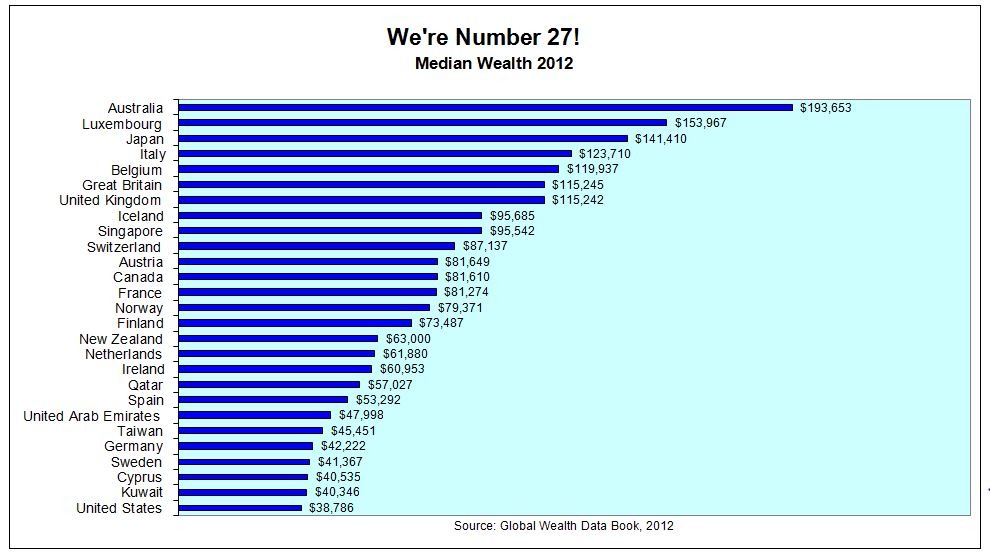
Maybe Im skipping some steps, but heres how I waste my time dreaming and realising how easy it is a wealthy person when I win powerball.
I ask you this, how HARD is it to have say $30 Million cash diminish to nothing as an individual? Under normal cost of living I postulate it is impossible in your lifetime unless you just spend it on really stupid things that you cant depreciate or even sell.
Inflation say 3%
Interest on cash...say in the US...2% (in Australia its like 6%...so after tax on earnings, you lose nothing or even propagate your investment)
Tax rate on high income....this is the kicker....is there one you could suggest in the US that compares to Australia? In Australia taxation on interest earning would be 39% if you are receiving say $1.8 Million in interest from our $30 Mil. From what Ive heard of the US...this isn't even close
So, your investment depreciates by 1.39% in value per annum in Australia...probably less than that in the US. Wow...that's risky. Why would I want to invest in anything where I could lose 5% to 100% of my investment and instead just live off the fat of my cash for say the next ...lets live big @$200K cash per year...new car every year that I throw away instead of sell.....hookers every night....never cook at home etc etc...I have somewhere between 100 and 150 years of the goodlife, generating some work fpr restaurants and manufacturing and prostituion sure...but not recycling the bulk the money which requires fast recycling in the economy for the economy to prosper.
I certainly see the problem. Its stopping a flow with major log jams of Large Worth individuals. There needs to be better mechanisms in place to stop this from occurring and tax sounds like a damn good place to start purely to incentivise creative use of the money.
Posted: Thu Jul 25, 2013 2:21 am
by raumvogel
Posted: Thu Jul 25, 2013 2:52 am
by Vortrog
Considering the average home here is about $350k, we are about ~30% leveraged. Id never run a development with that leverage unless I told investors they have a good chance of no or diminished return!
Posted: Thu Jul 25, 2013 3:47 am
by Camaro
Rich should be taxed at the same real-world scale as everyone else.
That means:
1) Graduated uniform income tax applicable to all sources of income (i.e. no tax advantaged sources of income).
2) Social Security & Medicare taxes payable on all sources of income as well (counts towards Social Security, so higher payouts as well).
3) If a Corporation want's "Person" status it will be taxed at the same uniform rates.
4) Seeing as how that would lead to significantly higher tax revenues at our current brackets, marginal rates would be brought down for everyone.
I don't think anyone could reasonably argue that such a system wouldn't be fair... and if they did it would expose their true beliefs.
Posted: Thu Jul 25, 2013 3:30 pm
by takingarms1
Vortrog wrote:QUOTE (Vortrog @ Jul 24 2013, 09:45 PM) there may be elements of propaganda, but not on this issue and particularly in the US where your tax system does not disincentivise massive cash investments in CASH.
How do you disincentivise massive cash investments? Massive inflation? We're doing a pretty good job of trying to inflate the money supply right now with QE2, etc and super low interest rates. It's not really doing much to increase inflation so far.
I know a few wealthy people in the US and none of them have massive cash investments. They're either in stocks, annuities, or real estate.
If I had $30 mil I'd surely keep a couple mil in cash, but I think I'd invest the bulk of it in relatively safe investments. Long term bonds, probably. But I'd surely also keep a few million in stocks or risky investments. I don't understand why anyone with half a brain would keep it all in cash?